Green Lacewing
Chrysopinae spp.
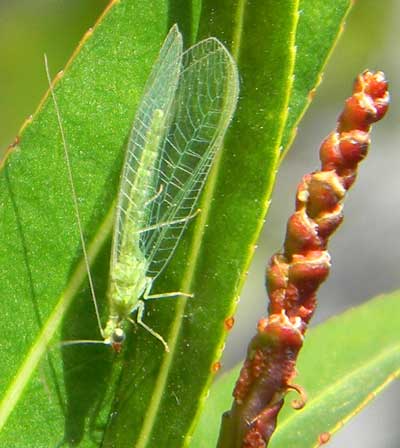
This lovely green lacewing was observed in the Ajo Mountains, Pima Co., Arizona, USA. 21 March 2010. It is resting on foliage of Mexican Jumping Bean, Sebastiania bilocularis
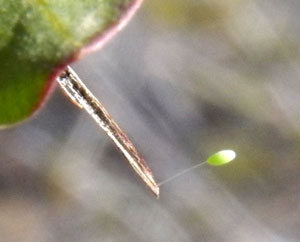
Here the egg is suspended atop a fine stalk which is further set at the tip of an ocotillo thorn.
Green lacewings are common insects across North America, including the Sonoran Desert. As adults they are mostly active from dusk to dawn when temperatures are milder and relative humidity higher. They are frequently attracted to lights and are among those burned up in electric bug-zappers. That is unfortunate because green lacewings are among the most beneficial of insects. In addition, the delicate beauty of these arthropods is something to behold.
It is the immature stage, or larva, of the green lacewing that earns beneficial status (insofar as humans are concerned). Lacewing larvae are wingless and are known as aphid lions because of their rapacious appetite for soft-bodied, plant-feeding insects. Without the services of lacewings, gardeners' efforts to grow flowers and vegetables would be considerably more difficult.
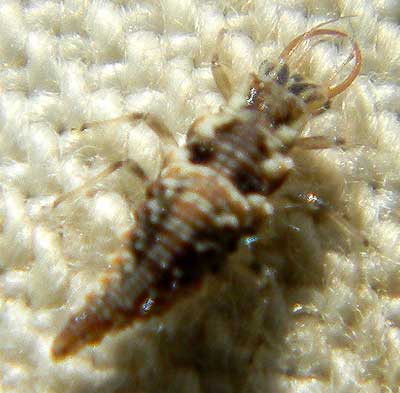
The head of this larva lacewing is at upper right. Notice the long, curved mandibles which are hollow - the larva sucks the liquid contents through them leaving its prey an empty hull.
Besides aphids, lacewings also consume many eggs of other insects that are laid upon vegetation. Lacewing eggs are protected from their egg-eating brethren by a fine, hair-like stalk that supports the egg above the plant surface and out of reach. When mature the larva produces a small cocoon and transforms into a pupa inside. The adult shown at left feeds on nectar. There are several very similar species of green lacewing.
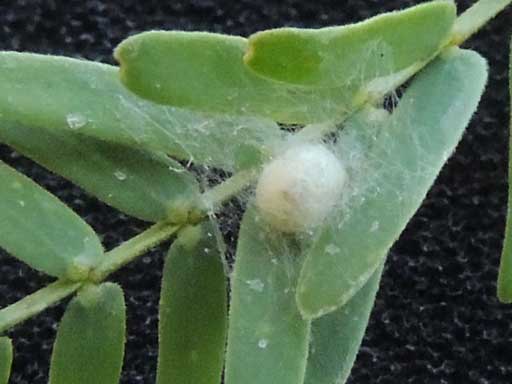
Cocoon on leaf of velvet mesquite. May 2022. Maricopa Co., Arizona.