Ironwood
Olneya tesota
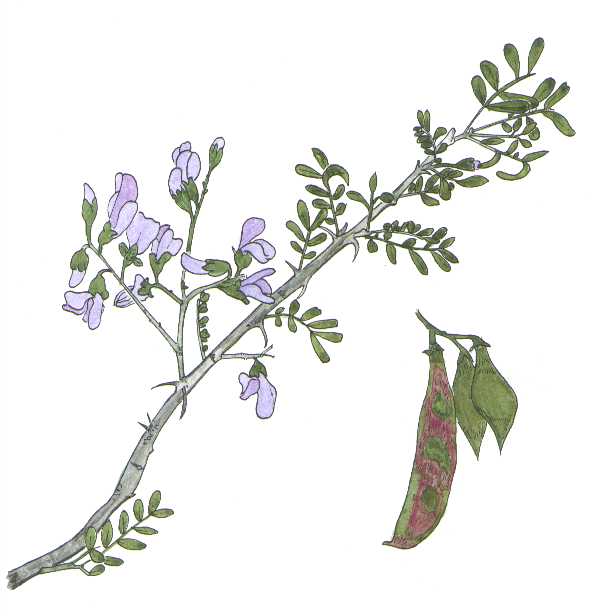
Watercolor from live specimen found near New River, Maricopa Co., Arizona, 30 May 1993.
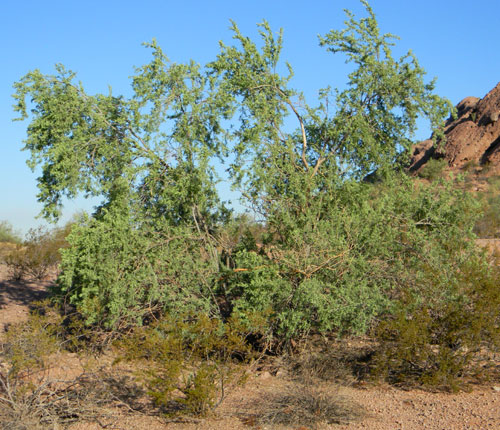
Observed at Papago Park in Phoenix, Arizona, USA. October 2011. The small shrubs growing nearby include Creosote Bush (Larrea tridentata) and Triangle-leaf Bursage (Ambrosia deltoidea).
TREE: An important and sometimes large tree occasionally taller than
12 meters. The bark of young branches is light to dark gray;
older bark is dark gray and deeply fissured. Upper lateral branches often arch
downwards reaching the ground level.
RANGE: Wash banks throughout the Sonoran Desert below
500 m elevation. This tree is a good indicator of frost severity and
was used as a guide to an area's suitability for citrus cultivation. Southwest
Arizona, southeast California and south into Mexico.
ARMED: Sharp and slightly curved spines occur in pairs at each
node.
LEAVES: Leaves are pinnately compound and evergreen. There are
usually an even number of leaflets, i.e. slightly offset pairs and no terminal
leaflet. Six to 20 leaflets. Well into the severe droughts evergreen Desert
Ironwood presents an unseemly verdant. Stems and leaves are all covered with
short, matted pubescence. At the base of each compound leaf are a pair if acute
stipules - these may either fall off or else grow longer and harden into paired
thorns.
FLOWERS: In May a profusion of lilac-colored flowers makes
this one of the most beautiful desert plants. Typical pea-type flower.
FRUIT: Bean pods are covered with a short, slightly sticky
pubescence and turn burgundy-brown as they ripen. Edible seeds have a flavor
resembling peanuts.
Fabaceae -- Bean Family
Sponsored Links:
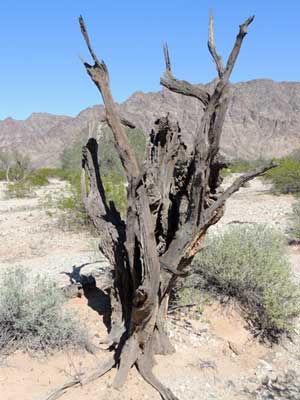
This tree lived in the Mohawk Mts. of Yuma Co., Arizona, and might have been hundreds of years old. How long ago it died and how long it will take for the wood decay is unknown. A tug on a branch showed that almost no decay has taken place so far! View a bigger image on Flickr.