Blue Palo Verde
Parkinsonia florida
(Cercidium floridum)
Sponsored Links:
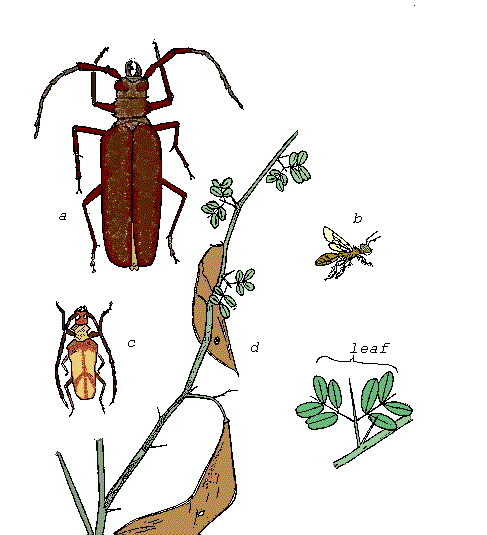
Watercolor from specimens found near
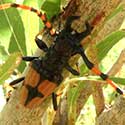
Buckeye Hills, Maricopa Co., AZ, 25 Nov. 1991. (a) Palo Verde Root
Borer, (b) Digger Bee,
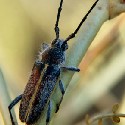
(c) Long-jawed Longhorn Beetle, (d) bean pod with
bruchid beetle exit hole.
Sponsored Links:
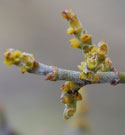
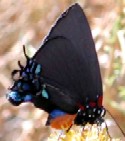
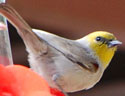
Blue Palo Verde often is a host for dark green clumps of parasitic desert mistletoe. The mistletoe then attracts Phainopeplas which eat the berries. Mistletoe is also a required host plant for one of the most gorgeous butterflies in the Sonoran Desert, the Great Purple Hairstreak. Follow the thumb links for more about these Palo Verde associates. Tiny birds called Verdins are likely to visit the trees in search of insect prey on a daily basis.
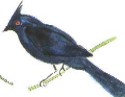
Verdin
TREE: All but the lower trunk
and largest branches are smooth and green, thus even when leafless the tree can
carry on photosynthesis. The trees are very often 4 to 6 m tall, but specimens
taller than 10 m are not uncommon.
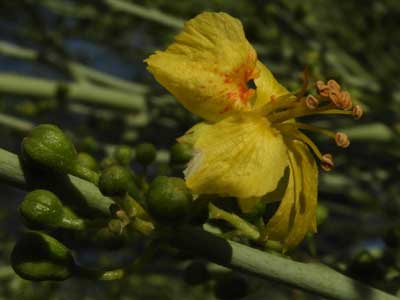
FLOWERS: Profuse clusters of bright yellow, five-petaled flowers in
March or April depending on elevation and rainfall. If moisture is present a
few flowers open through the summer months as well. The flowers like other
members of the Ceasalpinioideae are only slightly irregular, with only a vague
similarity to typical pea flowers.
LEAVES: Two or three pairs of four leaflets form a single, compound
leaf. Drought and frost deciduous.
ARMED: Short, slightly curved spines are arranged regularly along the
twigs. These are sharp and draw blood easily.
FRUIT: Seeds are very hard and smooth, slightly flattened with usually two
seeds per tan pod. The pods (d) remain attached to the tree well into the
winter months.
RANGE: Found throughout the range of the saguaro in Arizona, but more
likely to be encountered along the larger desert washes.
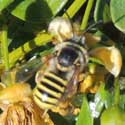
Because Blue Palo Verde typically grows along washes there is likely to be deep sandy soil nearby for the Digger Bee (b). The bees provision long tubular nests in the sand with pollen and nectar gathered from palo verdes. The bees are noticeably larger than Honey Bees. They are steel gray with large greenish eyes. John Alcock, in Sonoran Desert Summer, explores the fascinating biology of this species.
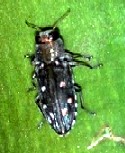
Flushing its new foliage in late May, the tender shoots of Blue Palo Verde are attractive to adult leaf beetles of the genera Cryptocephalus and Saxinus. These small, colorful beetles feed as adults on Palo Verde, but most likely have alternate host plants for larval development. The adult beetles are found mating on the new palo verde growth. Several kinds of longhorn beetles (a,c) use this tree as larvae.
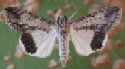
A small moth develops within the developing green pods causing significant seed loss on some trees. As with injuries to mesquite, the wounds caused by insect feeding ooze sap that attracts tiny wasps, flies, and ants. This minute but vital source of sweetened moisture comes at the end of May, when the desert is usually under an extended dry spell. Many other insects make their lives in and on the this desert tree, including the moth shown at right.