Arizonensis --> Sonoran Desert Naturalist --> Sonoran Desert Places --> Vulture Peak
|
Despite over a 100 years of sometimes intense human impact such as mining and ranching, this Upland Sonoran Desert area remains beautiful and alive with many wondrous desert plants and animals. The volcanic rocks are colorful and offer many wondrous hills and peaks. Head west out of Wickenburg, AZ, on US-60 heading to Los Angeles. Take Vulture Mine Road southbound at the Safeway store. The road maintained by Maricopa County is smooth and freshly paved. Some 8 miles south there is a BLM parking area and trailhead on the east side of the highway. (Notice: Do not turn on Vulture Peak road - the trailhead is about a mile further down the road.) A four wheel drive road will get you a mile closer to the peak ... but you will be missing some nice desert habitat to walk through. Be sure to sign either the upper and lower trail registers. I think it helps to let the BLM know the area is important to hikers and tourists. The view from the peak is well worth the effort. From the trailhead, the trail heads east and soon crosses a desert wash with an unusual name: "Syndicate Wash". Be sure to catch the trail on the opposite bank marked by cairnes. After the first kilometer the incline steepens and there is an abundance of loose stones and gravel. A good walking stick could help. For most people the pass is a good destination. The final few hundred meters to the summit is not maintained and requires agile climbing. |
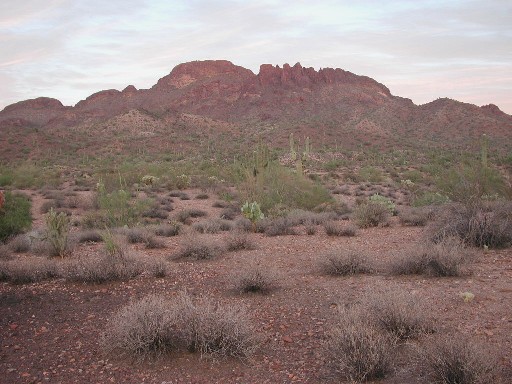
![]() With dusk the setting sun casts an orange-red glow on an already reddish mountain. A composition of 25-million-year-old volcanic tuff, brecca and rhyolite, that is soft and easily eroded, has helped sculpt the steep cliffs and rugged cuts. The rock is fairly water-permeable allowing a wide variety of plants to make good use of often scarce rainfall. |
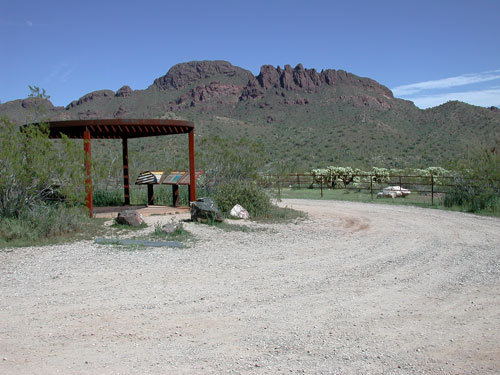
![]() There are interpretive signs and a covered seating area. Rough camping areas abound along the many jeep roads nearby. |
Google Map of Surrounding AreasView Larger Map. The road to Vulture Peak turns off US 60 to the south. A Safeway supermarket is at the intersection. |
Oct. 6, 2002Rains across the Sonoran Desert in late August and early September were very spotty ... and this area was lucky as evidenced by leafy ocotillos and an abundance of wildflowers! Over 30 species were found, most typically fall species, but a few that are typically spring flowers were found in bloom. See list at bottom of the page. Thousands of 3 cm long silken tents were in every foothill palo verde. These were made by caterpillars of a gelechiid moth (Bryotropha ineaqualis). The caterpillars feast on the tiny palo verde leaves before the plant would shed them anyway in a few weeks. Because the trees will shed these leaves soon, the tree does not protect them with phytochemicals, that is, the leaves are easy for the caterpillars to digest. No harm is done to the trees. At the trailhead gazebo and along the fences there are a number of widow spider webs (Latrodectus sp). The glistening silk webs extend obout 1/2 meter above the ground to some very secure hiding spot created by a crevice or opening. These man-made hideouts are necessary for the spiders to escape their own predators and parasites and thus the spiders are most numerous near these structures. Naturally, such secure cavities are rare and limit the spiders' abundance. The webs are especially designed to catch insects that crawl along the ground; a gentle pull on one of these strands will demonstrate the strong, tough silk characteristic of widow spiders. |
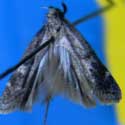
The moth responsible for the silken tents in the palo verde trees is similar to this one that is found in Finland. |
BirdsThis bird list, with the more common species listed first, is very typical of the Sonoran Desert:
|
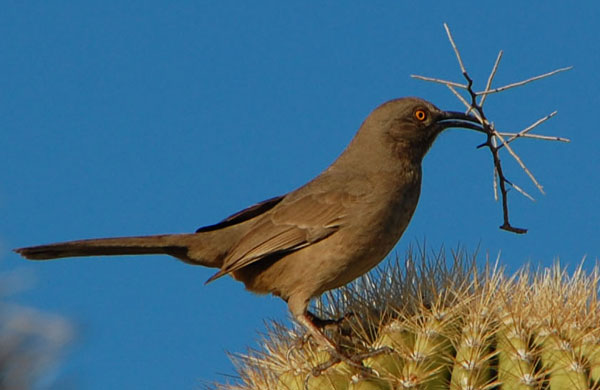
This photograph of a Curve-billed Thrasher, Toxostoma curvirostre, was taken by Rich Ditch -- a master of birds and bird photography. You can access the rest of his online work at Birds in Nature. Sponsored Links |
MammalsReptiles
|
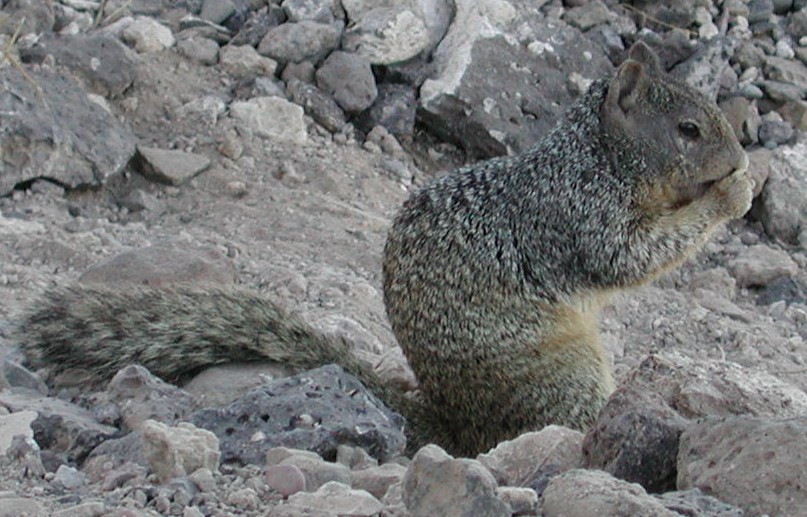
![]() The rock squirrel is the largest of the Sonoran Desert squirrels. It nest in the ground and rarely climbs trees. |
|
In general order of Abundance:
Sponsored Links |
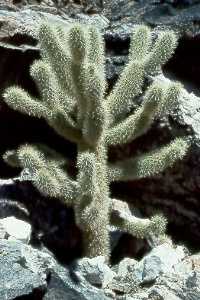
Teddybear Cholla (Cylindropuntia bigelovii), Photographed April 6, 1979. |
Upper Sonoran Desert Scrub interspersed with Mojavean and Desert Grassland elements:
|
|
|
Chinchweed (Pectis papposa) .
|
Sonoran Desert Naturalist
Home Page
Desert Places
Field Guide