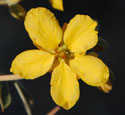
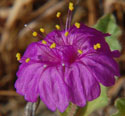
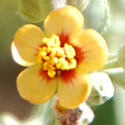
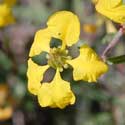
White Tank Mountain Park offers West Valley residents a vast area of Sonoran Desert and mountain hiking with easy access. It lies at the far west of the Phoenix Metropolitan area (This statement is quickly becoming false as new communities are constructed on the far west side of the White Tanks). Reach the park by driving west on Olive Ave from Glendale through farmland, orchards and open spaces needed for Luke Air Force Base. The park entrance is at the end of Olive Avenue. This is the largest of the Maricopa County parks occupying nearly a full 6 mi. x 6 mi. section. Park elevation ranges from 420 m up to 1200 m. There are four main trails up into the mountains. From the park entrance at the south they are Goat Canyon, Waterfall Canyon, Mesquite Canyon, and Ford Canyon.
The geology across the range is complex. Along the eastern slopes where the trails begin there is granitic pluton formed in the late Cretaceous to early Tertiary periods. Further west ancient metamorphic terrain composed of schist and a wide variety of other minerals. Find more detailed geologic information by ASU Professor Steven Wood.
For now the White-tanks are a good place for serious star-gazing because city lights have not sprawled so close. This is a perfect reason to stay overnight at the campground (fees apply). Read about how long after sunset it will be dark enough.
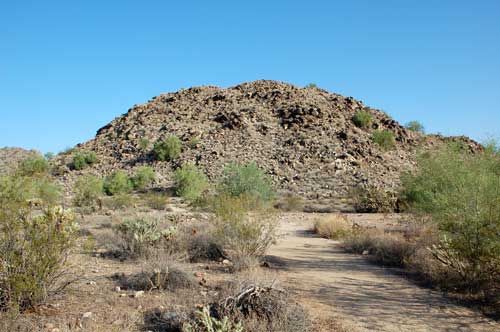
View from Black Rock Loop Trail at White Tank Mountains Park. This outcrop of boulders is derived from granite plutons formed during the late Cretaceous or early Tertiary periods.
Map of White Tanks and Vicinity
View White Tank Mountains in a larger map
Directions: From Phoenix drive west on Dunlap which becomes Olive Ave. though Glendale. From the intersection of Olive and Grand Ave. it is some 27 km (16 miles) to the park entrance continuing on Olive. Thus it might save time to drive Loop 303, Estrella Pkwy. and exit at Olive and continue west. Entrance fee $7.00. Nearby areas on the Sonoran Desert Naturalist include Hedgepeth Hills in Glendale and Estrella Park s. of Goodyear. Find more information about visiting the park at the official Maricopa Parks page.
 I spotted a
wine-colored
I spotted a
wine-colored 


 "
"